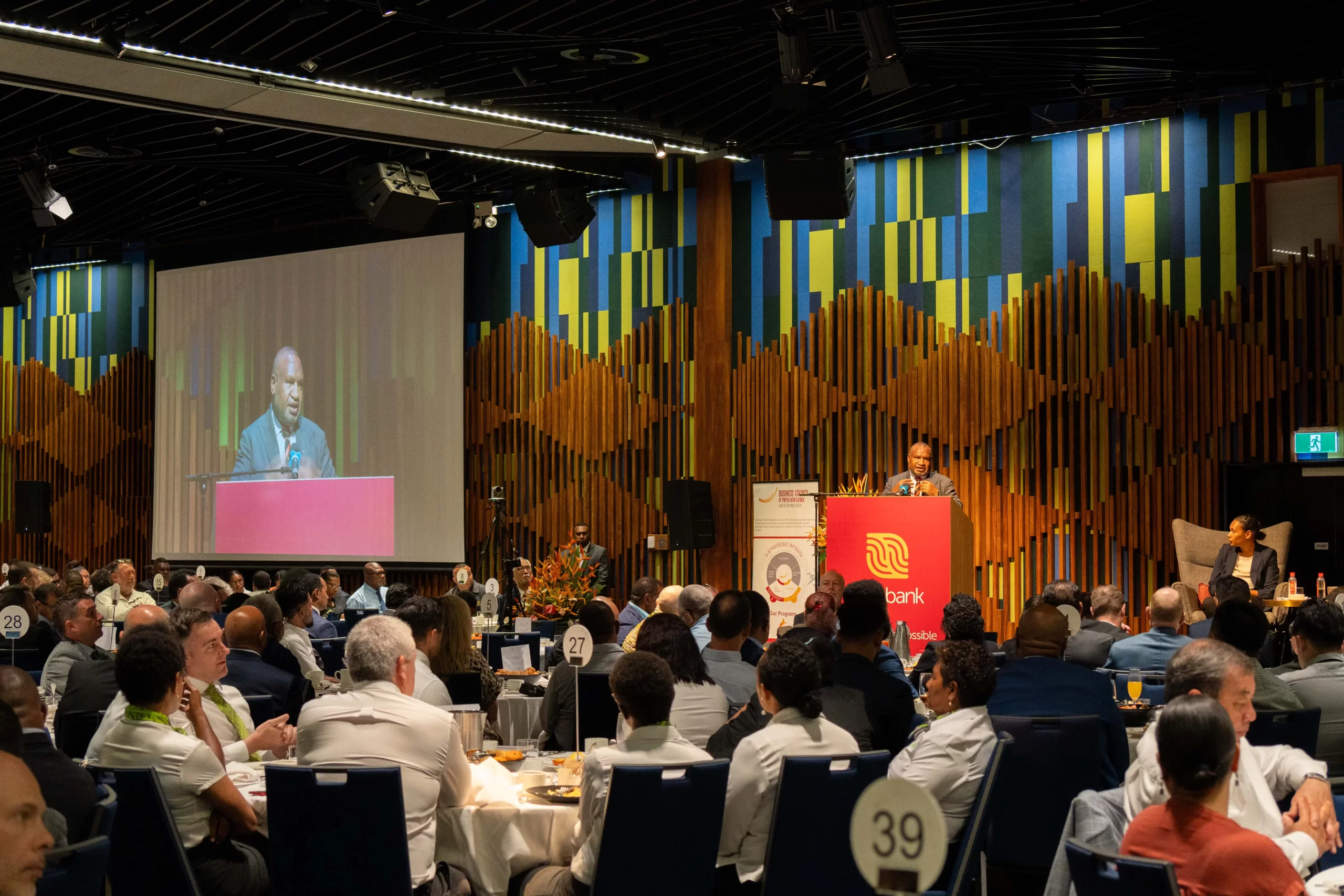
On behalf of the President and Executive of the Business Council, welcome and thank for your support and attendance at the 5th 'Back to Business' breakfast.
A specific acknowledgement to the Prime Minister James Marape, for his 8th attendance at our event , to to give so generously of his time to discuss and share the Governmen’s priorities for 2025. I also warmly welcome Mr. Vidovich, the Chief Executive Officer of Kina Bank Limited on his first attendance at the breakfast in his new role. We look forward to hearing Kina Bank’s 2025 outlook and engaging in an insightful panel discussion with PM. As always, thankful for Kina’s ongoing support to partner with Business Council PNG in hosting this national event that brings business leaders from all over the country to engage meaningfully on what the coming year has in store for us.
W’ve just observed a minute’s silence for the late Sir Julius Chan, one of the founding fathers and key architects of our country’s independence.
On the eve of PNG’s 50th celebration of sovereignty and independence, it is fitting that we acknowledge the achievements and efforts of Sir Julius, and a great pity that he will not be there in person to celebrate his greatest legacy.
It is also appropriate to acknowledge other pioneers that we have recently lost, Sir Charles Lepani and Sir Paul Bengo, both part of an incredible cohort of young, dedicated, and vibrant men and women, who ushered in a new nation on September 16th, 1975.
These names, and the names of many PNG hero’s will be remembered and recognised as we make plans to celebrate the 50th anniversary of the wonderful gift that they have bequeathed to all of us.
My name is Courtney Boustridge, the Treasurer of the Business Council of PNG, and it is my pleasure to welcome you on behalf of our President Susil Nelson-Kongoi and the Executive. Our President could not be with us today and extends her thanks for your attendance and apologies for not being here.
I would now like to deliver our President‟s speech for this occasion….
INTRODUCTION
In order for the Kumul to display elegance, vitality and strength, like all birds, the strength of its wings must prevail. This basic observation is central in the mythology of several regions to describe the necessity of partnership. Where the absence of collaboration, teamwork, bung will not make the family strong: husband and wife; clans and the tribe will be divided. Therefore, the wings must rise, function and operate in unison to display the majestic Kumul.
PARTNERSHIP
As we reflect on Papua New Guinea and its 50-year journey, where we are today, as a vibrant democratic free nation, the partnership of government and the private sector has played a significant role in our shared prosperity. Through incentives of plantation ownership schemes, our people started becoming active members of the market and in many cases, opened their own bank accounts, a revolution in its own right. The coffee story brought many people to the fertile highlands valleys and together a vibrant economy was created that has brought millions into the 21st century.
Building urban communities to be hubs of trade, commerce and government services forged a vibrant middle class. Recent numbers from banks and financial institutions indicate over a million clients are actively securing homes, actively building their superannuation and securing the next generation of Papua New Guineans affordable health care and quality education.
Perhaps the one demonstrable legacy is the PNG Pasin; leaving no one behind. This is a beacon of the government business partnership. Where the partnership has worked tirelessly to leverage investments to bring positive change to our people. From building energy grids, schools, hospitals to unlocking our natural resources to lift our people out of poverty.
The business story of PNG is a nation buildings story and one all of us in this room should be deeply proud of.
2024 GOVERNMENT BUSINESS PARTNERSHIP
While there is much to be cheerful about, there is also more to do. This is one of the main reasons the PM agreed with the Council last year to continue working towards impactful partnerships and actionable dialogues. As a result, a total of 27 Technical Working Group (TWG) meetings were successfully held, demonstrating a strong commitment to ongoing collaboration and dialogue.
The Business Council also hosted key events, including the 14th PM’s Breakfast, Speakers Breakfast, and Chief Justice’s Breakfast, all of which were successfully executed). Additionally, 3 G2BCFs (Government-to-Business Consultative Forums) were hosted, facilitating critical conversations between the business sector and government officials, and a newly created Task Force hosted its first meeting. Moreover, all 3 PGK (Praivet Gavamani Konekt 1) meetings were successfully executed, further reinforcing the productive partnership between the two sectors.
These conversations fuel change and in critical times when the PM had to lean in for our insights on market reform, he has actively sought our views through this framework. The Council thanks the Chief Secretary and his staff, Executive Director Carmella Gabina and the BCPNG Secretariat, and you the members, for progressing and participating in these important engagements.
2025 FOCUS
Recognising the need to capitalise on these critical engagements, The Council is contributing K400,000.00 this year. This is an increase from the K350,000 we committed last year. This resource will support the following core activities:
- Business Security Dialogue: As we mentioned last year at this breakfast and based on observations from the last 12 months, heightened crime and violence such as the Jan 10 riots and the violence in Enga is a wake up call to find solutions to arrest this development negator. To kick off this important engagement, after today’s breakfast, the First Praivet Gavamani Konekt will focus on Market Protection both from internal and external threats. Thank you to the 16 experts ranging from security practitioners,to government officials and international analysts that have been closely watching Papua New Guinea's security ecosystem. With over 70 confirmed participants it is a clear indicator this is an important subject for all of us.
- Strong Economy Dialogue: Complementing the Governor of Bank of Papua New Guinea’s Quarterly Monetary Policy Statements and Treasurer’s Final Budget Outcomes and Mid Year Economic Financial Outlook, the Business Council will undergo critical consultations on the productivity, market performance and the various risks impacting the Private Sector. We are confident these discussions will complement Governments Monetary and Fiscal Policy.
- MTDP 4 Dialogue: As mentioned by Past President Nuni Kulu, "Nation Building is everybody's business", and the active participation of the Private Sector in the implementation of the MTDP4 is integral. An example that illustrates this observation is the Prime Minister’s “Partial Privatisation of PNG Power Limited” announcement. The market has responded with keen interest on the opportunities that may come from this policy direction. In particular, large energy customers, Independent Power Producers and Investors have all expressed a desire to actively participate in the future of PPL. On that note, the PM has agreed for the Chief Secretary to coordinate activity with the Business Council in his regular Consultative Forum Meetings to hear from the market. Those of you that are keenly following this policy are encouraged to actively participate in these engagements.
- Futures Forum: emerging technologies and sectors such as AI and biotechnology to bring efficiencies to the market place. This engagement intends to discuss technology adoptions to not only benefit businesses but how these products become accessible to everyone including our vulnerable. Starlink is a global game changer and we are already witnessing its positive impact in the Pacific and remote communities in Australia. We all look forward to their entry into the market so our vulnerable communities can access this impactful technology.
- Jobs Campaign: Over the past 5 years, through the Fresh Produce Program, the Business Council has engaged over a hundred interns to experience government business relations. It has been an astounding success where they have actively formulated and managed all the Councils engagements and these experiences have been life changing with 95% of them now employed in government and business sectors. We will be hosting a Forum to promote internships as it is evident an internship experience for our college and university students is imperative in Nation Building.
We urge members of the private sector and government officials, cabinet ministers, to walk with Prime Minister and the Council, to actively formulate ideas and drive important change for our country in these important engagements.
CONCLUDING REMARKS
The Business Council of PNG remains committed to working hand-in-hand with the government and all stakeholders to ensure that we continue on the path of sustainable development. By staying united and applying common sense, I believe we can overcome the challenges ahead and make 2025 a year of positive change for everyone. Together, the wings of nation building will prevail. Thank you.