
PM Marape Announces Major Tax Reforms to Boost Investment and Economic Growth

Feb 27, 2025

Port Moresby, Papua New Guinea, February 4, 2025 – Prime Minister James Marape has announced a bold tax reform strategy aimed at fostering investment, increasing consumer spending, and driving local industry growth. The reforms will take effect once Papua New Guinea’s economy reaches a K150 billion milestone, a target expected to be achieved within the next three to four years. He announced this at the Back to Business Breakfast in Port Moresby today.

The Prime Minister emphasised that these changes will create a business-friendly environment, ensuring that economic expansion benefits both investors and citizens.

Prime Minister Marape outlined key tax initiatives that will come into effect once PNG reaches the K150 billion economic threshold:

  • Lowering corporate tax to encourage business expansion and attract further investment.
  • Reducing personal income tax to increase disposable income and boost domestic consumption.
  • Implementing stricter capital outflow regulations to ensure funds are reinvested locally rather than leaving the country.

“These tax reductions will create the conditions necessary for businesses to thrive, ensuring that investment remains in Papua New Guinea and continues to support employment, infrastructure, and industry growth,” said Prime Minister Marape.

To further strengthen PNG’s economic position, the government is focusing on Special Economic Zones (SEZs), including a tax-free business hub in Manus Province, designed to attract regional trade, investment, and industrial development.

“Our vision is to position Manus as a strategic trade hub, opening up new economic opportunities and fostering partnerships with businesses seeking to expand in the Asia-Pacific region,” said the Prime Minister.

Prime Minister Marape also called upon leading business organisations, including the PNG Chamber of Commerce, the PNG Business Council, the Manufacturers Council, and the Chamber of Resources and Energy, to collaborate with the government in identifying growth opportunities and shaping investor-friendly policies.

He highlighted import replacement and local manufacturing as key government priorities, urging multinational and domestic firms such as Trukai Industries and those in the food sector to invest in local production to reduce PNG’s dependence on imports.

“With the right incentives, streamlined regulations, and stronger industry collaboration, we can transform PNG into a regional centre for manufacturing and downstream processing,” the Prime Minister added.

The government is committed to:

  • Reducing bureaucratic barriers to make investment easier and more efficient.
  • Encouraging foreign and domestic businesses to scale their operations in PNG.
  • Developing an industrial and manufacturing base to create jobs and reduce reliance on imports.

“This is a defining moment for Papua New Guinea’s economy,” said Prime Minister Marape.

“We are restructuring our fiscal policies to ensure PNG remains an attractive destination for investment while delivering tangible benefits for businesses, workers, and the wider population.”

The Marape-Rosso Government remains focused on building a robust, sustainable economy that supports private sector growth, employment creation, and long-term prosperity for Papua New Guinea.
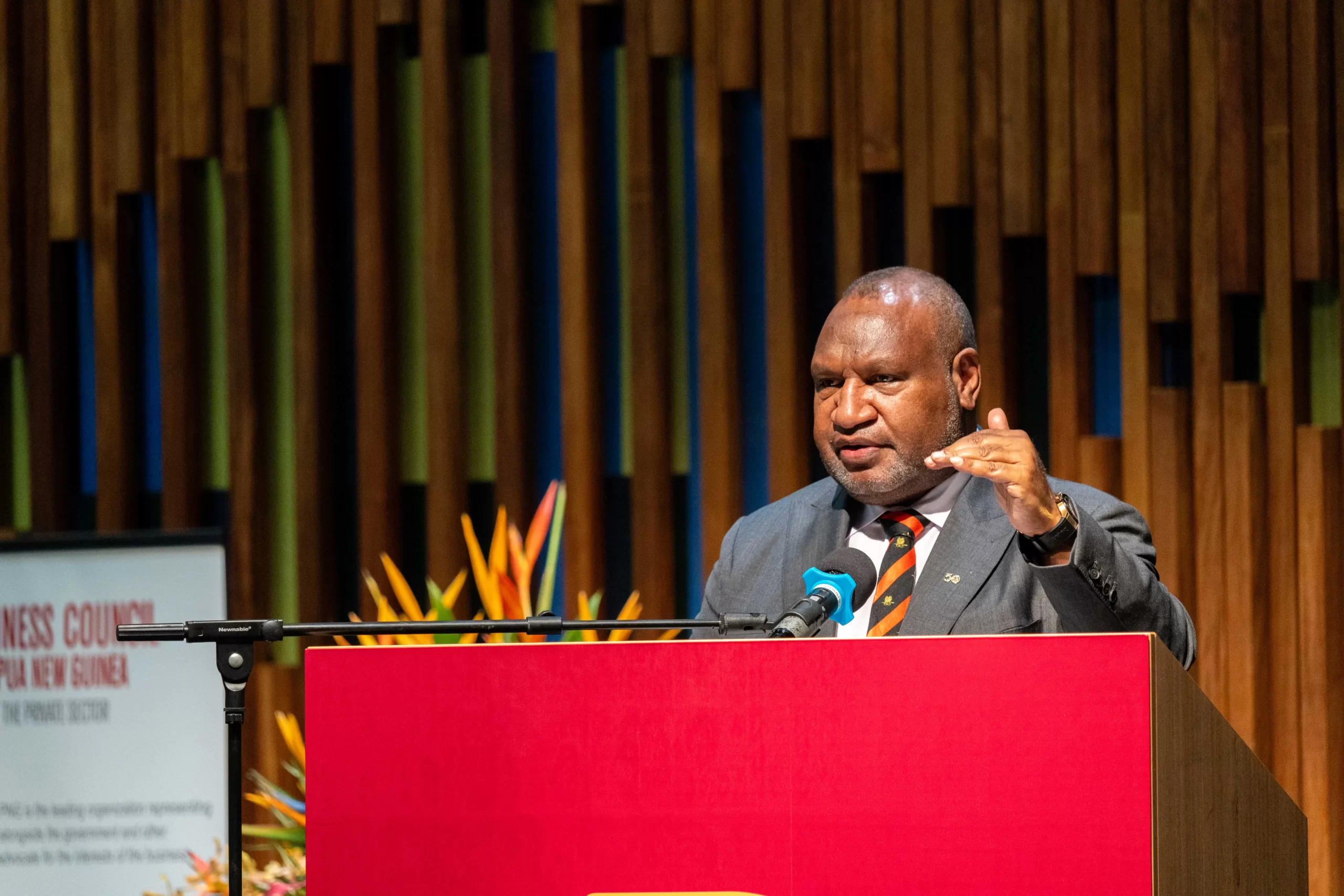
The Business Council of Papua New Guinea (BCPNG), in partnership with the United Nations Development Programme (UNDP) through the European Union-funded Preventing and Countering Corruption in Papua New Guinea Project, brought together leaders from the judiciary, private sector, government, civil society and development partners for a series of engagements focused on strengthening trust, institutional integrity and confidence in Papua New Guinea’s business environment.

The engagements began on 18 August 2026 at the Hilton Hotel in Port Moresby with the Chief Justice’s Business Breakfast, followed by Private Gavamani Konekt 3 (PGK3). The programme continued on 20 August with a workshop focused on practical tools for strengthening business integrity in the private sector.

Together, the events created a platform for discussing how justice, governance, integrity and innovation intersect with business confidence, investment and sustainable economic development in Papua New Guinea.

Chief Justice’s Business Breakfast: Strengthening Confidence Through Justice and Integrity

Held under the theme “Justice, Integrity and Innovation: Strengthening Markets and Governance in PNG,” the Chief Justice’s Business Breakfast placed the role of strong and trusted institutions at the centre of the discussion.

Chief Justice Sir Gibuna Gibbs Salika highlighted the importance of the rule of law, judicial integrity and institutional confidence in supporting economic activity and national development.

His remarks reinforced the importance of businesses and investors being able to operate in an environment where laws are predictable, contracts can be enforced and disputes can be resolved fairly and efficiently.

The Chief Justice also reflected on continuing reforms within the justice sector, including improved case management, judicial education and the growing use of technology.

Emerging issues such as artificial intelligence, digital evidence, privacy and cybersecurity were highlighted as areas requiring careful consideration as PNG’s justice system and wider economy continue to evolve.

A key message from the breakfast was that innovation must strengthen access to justice, transparency and efficiency while preserving fairness, accountability, judicial independence and sound human judgement.

The discussion also reinforced the connection between strong institutions and the confidence required for investment, commercial activity and long-term economic growth.

PGK3: Connecting Justice, Governance and the Business Environment

Following the breakfast, PGK3 expanded the dialogue through five focused sessions examining issues increasingly important to both government and the private sector.

The forum covered financial crime, anti-money laundering and economic integrity; artificial intelligence, digital evidence and the future of justice; land, the green economy and environmental justice; judicial reform, security and investor confidence; and arbitration, mediation and alternative dispute resolution.

Participants explored how stronger information-sharing, transparency and institutional coordination can contribute to more trusted and resilient markets.

The discussions on financial and economic integrity highlighted the importance of reliable systems, corporate transparency and collaboration between regulators, government agencies and businesses.

Technology also featured prominently throughout PGK3. As more government, financial and commercial systems become digital, the forum recognised the growing importance of cybersecurity, data integrity and responsible approaches to emerging technologies such as artificial intelligence.

The land and environmental justice session considered the need to balance economic development with customary land interests, environmental stewardship and the long-term sustainability of PNG’s natural resources.

Investor confidence and commercial justice were also central themes. Participants considered how efficient judicial processes, predictable regulation and stronger dispute-resolution mechanisms can reduce uncertainty and support a more competitive business environment.

The forum also highlighted the role of mediation and arbitration as practical mechanisms for resolving commercial disputes, potentially reducing delays, transaction costs and pressure on the courts.

Across the discussions, a consistent message emerged: improving PNG’s business environment is not simply about introducing new policies or institutions, but ensuring that existing laws, systems and institutions work effectively and consistently.

Business Integrity Workshop: Moving from Dialogue to Practical Action

The week’s engagements continued on 20 August with the Workshop on Practical Tools for Strengthening Business Integrity in the Private Sector.

The workshop, delivered through the EU-funded PNG Anti-Corruption Project in partnership with UNDP and BCPNG, focused on practical approaches businesses can use to strengthen ethical conduct, compliance and organisational integrity.

Participants examined PNG’s existing anti-corruption framework and considered how private sector organisations can strengthen internal governance and reduce corruption risks.

The workshop also explored a proposed model approach to business integrity, including principles around transparency, accountability, ethical conduct, fair competition, information integrity and responsible engagement with communities.

Whistleblower protection was another important area of discussion, alongside the importance of clear reporting processes, confidentiality and organisational systems that encourage concerns to be raised safely and appropriately.

A strong emphasis was placed on prevention—through education, awareness, clear procedures, ethical leadership and stronger internal systems—rather than relying solely on investigations after misconduct has occurred.

The workshop also provided an opportunity for businesses and stakeholders to contribute practical feedback on how integrity tools could be applied within Papua New Guinea’s private sector.

Building Stronger Institutions Through Collaboration

Taken together, the Chief Justice’s Business Breakfast, PGK3 and the business integrity workshop demonstrated the value of sustained dialogue between the institutions and organisations that influence Papua New Guinea’s economic environment.

For BCPNG, these engagements are an important part of connecting the experiences of businesses with the institutions responsible for justice, regulation, governance and national development.

By bringing the judiciary, private sector, government, civil society and development partners into the same conversation, BCPNG continues to provide a platform for constructive engagement on issues that directly influence business confidence and investment.

The week’s discussions reinforced a clear principle: stronger markets depend on trusted institutions, effective systems and a shared commitment to integrity.

BCPNG will continue to support Government-to-Business dialogue and practical collaboration that contributes to stronger governance, responsible business practices and sustainable economic growth in Papua New Guinea.